Why Enterprise AI Pilots Stall
Most enterprise AI pilots don't fail because the technology doesn't work. They stall because of scope, governance, and stakeholder problems that were present from the start.
The Pattern
An enterprise team runs an AI pilot. The results look promising. The demo goes well. Then six months later, the pilot is still a pilot. No production deployment. Nobody is quite sure why it hasn't moved forward.
I've seen this pattern often enough that the causes are pretty predictable. They're almost never technical.
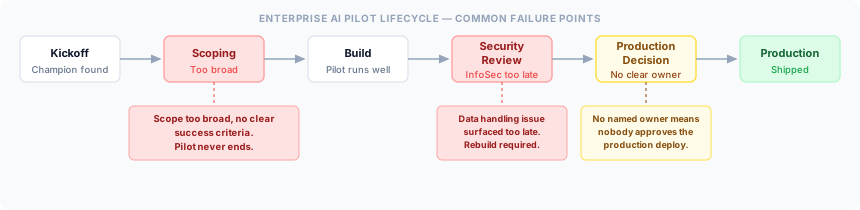
The Scope Was Too Broad
The most common version: the pilot was scoped as "AI assistant for the operations team" or "AI-powered document processing." Both of those describe a category of solution, not a specific problem with measurable outcomes.
Successful AI pilots are narrow. Not "automate customer support" but "classify inbound support tickets by category and priority before they reach the queue." Not "AI for HR" but "generate first-draft onboarding documentation from a structured intake form." Narrow enough that you can define what success looks like in a single sentence.
When scope is broad, success is hard to define, which means there's no clear moment where the pilot "worked" and can move to production. It just keeps running indefinitely.
InfoSec Wasn't Involved Early Enough
I've watched pilots get killed at the production approval stage because a security review surfaced a data handling issue that was baked into the architecture from day one. Fixing it at that stage required rebuilding significant parts of the workflow. The business case didn't survive the delay.
If the AI workflow touches any data that could be considered sensitive (and in enterprise environments, that's most data), get InfoSec involved during design, not at sign-off. The questions they'll ask are: what data is being sent to the model API, where is it stored, who can see it, and what's the retention policy? You should have clean answers to all of these before you write the first prompt.
This is especially important if you're using an external model API. Many enterprises have policies around what data can leave their environment. Building a workflow that violates that policy and discovering it at the production gate is expensive.
No Clear Owner After the Pilot
Pilots have champions. Production deployments need owners. These are different things. A champion will push the project through internal approval and find budget for the pilot. An owner will monitor it in production, handle incidents, manage the vendor relationship, and update the prompts when they start drifting.
Before a pilot goes to production, there should be a named individual (not a team, an individual) who owns it. They need to understand how it works, have the access to fix it when something goes wrong, and have the mandate to make decisions about it. If you can't identify that person, the pilot isn't ready to be a production system regardless of how well the technology works.
Success Metrics Were Defined Too Late
"We'll measure success after we see what the pilot produces" sounds reasonable and is a reliable way to end up with a result that nobody can evaluate clearly.
Define success criteria before the pilot starts. Not after. Ideally: a specific metric, a target value, and a timeframe. "Reduce average ticket triage time from 4 hours to under 30 minutes within 60 days" is a success criterion. "Improve efficiency" is not.
When you have clear criteria defined upfront, you can make a production decision based on evidence. Without them, you're relying on subjective impression, which means the decision will be influenced by whoever has the strongest opinion at the time.
What a Well-Structured Pilot Looks Like
The ones that make it to production tend to share a few characteristics:
- One specific workflow with a measurable outcome
- InfoSec reviewed the data handling before any code was written
- A named production owner identified before the pilot launched
- Success criteria defined at kickoff, not retrospectively
- A realistic timeline with a defined decision point at the end
The pilot is not an experiment. It's a structured evaluation with a clear decision at the end: deploy to production, modify and re-test, or stop.
The question to ask at kickoff is not "what could we do with AI?" It's "what specific problem are we trying to solve, how will we know if we solved it, and who owns this after the pilot ends?"