What Model Context Protocol Actually Changes
MCP is getting a lot of attention. Here's what it actually does, where it matters for enterprise AI, and where it doesn't change anything yet.
The Hype vs. What It Actually Does
Model Context Protocol (MCP) has generated a lot of noise since Anthropic published the spec. Most of the coverage describes it as a "universal standard for AI tool use" which is technically accurate and practically unhelpful for anyone trying to decide whether to build with it.
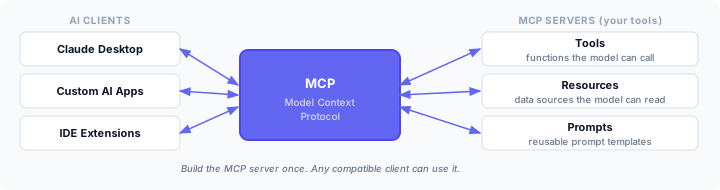
Here's the concrete version: MCP is a standardized protocol that lets AI models connect to external tools and data sources through a common interface. Instead of building a custom integration for every model-to-tool connection, you build an MCP server once and any MCP-compatible client can use it.
That's the idea. The practical implications depend heavily on where you are in your AI adoption curve.
Why the Standardization Actually Matters
Before MCP, every AI platform handled tool use differently. OpenAI had function calling in one format. Anthropic had tool use in another. An integration you built for one didn't work with the other without a rewrite.
MCP doesn't fully solve this yet (client support is still maturing), but the trajectory is clear. If you build an MCP server that exposes your internal ticketing system or your CRM data, that server becomes reusable across AI platforms that support the protocol. You write the integration once.
For enterprise environments, this changes the build-vs-maintain equation. A well-built MCP server for your HR system or your documentation platform becomes shared infrastructure for AI tooling rather than a one-off integration for a specific agent.
What an MCP Server Actually Looks Like
An MCP server exposes three types of things:
Tools are functions the model can call. Search a database, create a ticket, send a notification. The model decides when to call them based on the conversation context.
Resources are data sources the model can read. A document store, a configuration file, a knowledge base. The model can pull these in as context rather than having them pre-loaded in the prompt.
Prompts are reusable prompt templates that the client can invoke. Less commonly used but useful for standardizing how certain tasks get framed.
from mcp.server import Server
from mcp.types import Tool, TextContent

server = Server("internal-tools")

@server.list_tools()
async def list_tools():
    return [
        Tool(
            name="search_tickets",
            description="Search open support tickets by keyword",
            inputSchema={
                "type": "object",
                "properties": {
                    "query": {"type": "string"},
                    "status": {"type": "string", "enum": ["open", "closed", "all"]}
                },
                "required": ["query"]
            }
        )
    ]

@server.call_tool()
async def call_tool(name: str, arguments: dict):
    if name == "search_tickets":
        results = await search_tickets_db(arguments["query"], arguments.get("status", "open"))
        return [TextContent(type="text", text=str(results))]
Where Enterprise Teams Should Pay Attention
Internal knowledge retrieval. The most immediately valuable use case is giving AI agents controlled access to internal documentation, runbooks, and knowledge bases. An MCP server in front of your Confluence instance or SharePoint is a better pattern than dumping documents into prompts.
Controlled system access. MCP servers can expose specific, scoped operations to AI models without giving them broad API access. Instead of an agent that can do anything with your CRM, you build an MCP server that exposes exactly the operations the agent should be allowed to perform.
Auditability. Because MCP tool calls are structured and logged at the server level, you get a clear record of what the AI accessed and what it did. That matters for compliance-heavy enterprise environments.
Where It Doesn't Change Anything Yet
MCP doesn't solve the hard problems in enterprise AI: data governance, model output quality, hallucination in high-stakes decisions, or the organizational challenges of getting AI workflows approved and adopted. Those are still people and process problems.
It also requires the host application to support MCP. Claude Desktop and a growing list of AI tools support it natively. If you're building on top of a platform that doesn't, you're not getting the interoperability benefits yet.
MCP is most valuable as a design pattern even if you never use the protocol directly. Build your AI tool integrations as discrete, scoped servers rather than monolithic functions and you'll be in a better position regardless of which protocol wins.