Designing Secure Enterprise SSO Workflows
The SSO configuration itself is rarely where implementations break. It's the things that come up after you think it's done.
Nobody Warns You About This Part
I've set up enterprise SSO more times than I can count. Things like SAML assertions, metadata exchange, and attribute mapping are usually straightforward once you've done a few. What kills these implementations is what happens after you think it's done.
A client calls two years later because their SSO stopped working. Not because anyone changed the configuration. Because the SAML signing certificate expired and nobody had a rotation procedure. That's the most predictable failure mode in enterprise SSO and it catches almost everyone.
Before anything else: check the cert expiry date, document it, and make sure someone owns the renewal process. Everything else is secondary.
SAML or OIDC
In most enterprise environments, you don't really get to choose. If the organization is running Entra ID or Okta at scale, they have SAML federation already configured and the IT team knows how to work with it. OIDC is gaining ground with newer SaaS platforms, but trying to push an organization toward OIDC when their infrastructure is built around SAML will add weeks to the engagement for no real benefit.
The question I actually ask is: what does the IT team already know how to operate? That's usually the right answer.
Attribute Mapping Is Where It Breaks
Protocol config is mostly mechanical. Attribute mapping is where the implementation actually fails.
Entra ID sends group membership claims as object GUIDs by default, not display names. This breaks role-based access control for almost every platform that expects group names. You either add a claims transformation rule in Entra ID to send display names, or the platform has to handle GUID lookup (and most don't). Nobody documents this well. I've seen it burn an entire integration sprint.
The other one: NameID format. If you configure an integration with NameID format set to emailAddress and later someone switches it to persistent (or vice versa), the platform creates duplicate accounts for existing users. Silent, confusing, hard to clean up. Lock down the NameID format in your documentation and make sure it matches what was used during testing.
Test the Paths Nobody Tests
Most integrations get tested with a single happy-path login. Before signing off:
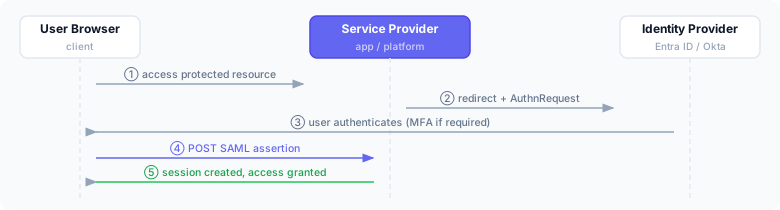
- Test SP-initiated and IdP-initiated login separately. They behave differently and platforms sometimes support one but not the other cleanly.
- Test what happens when the assertion is expired. Does the platform show a useful error or just a blank page?
- Test with a user who has no group memberships. Missing claims fail silently more often than they fail loudly.
- Test the logout flow. Single logout (SLO) is frequently broken or not implemented, and if a user closes the browser thinking they're logged out of the IdP, they're usually not.
The Security Team Checklist
Enterprise security teams will have requirements that go beyond getting login to work. Plan to address these before they surface in a review:
- Session duration: how long authenticated sessions stay valid without re-authentication
- MFA enforcement: applied at the IdP, the application, or both? Know the answer before the security questionnaire arrives.
- Certificate rotation: plan it before go-live, not after the first expiry
- Audit logs: both the IdP and the application should be capturing authentication events -- confirm this explicitly
One thing I always confirm in writing: who owns certificate rotation after handoff. If nobody claims it, it doesn't get done.
Pre-Signoff Checklist
- NameID format confirmed, documented, and locked
- Group claim format tested end-to-end with RBAC
- SP-initiated and IdP-initiated flows tested
- Error states tested: expired assertion, unknown user, missing attributes
- Certificate expiry date documented and owner assigned
- SLO behavior confirmed or explicitly excluded from scope
- Rollback procedure documented